Roof-mounted thermal camera
A fixed elevated viewpoint helps scan the site for heat signatures and movement after dark, including places that are hard to assess by eye.
On location / overnight
Mobile wildlife monitoring brings our cameras to your site in Cheshire or the North West for an overnight watch. We combine thermal detection, optical detail and activity alerts to see what happens after daylight fades.
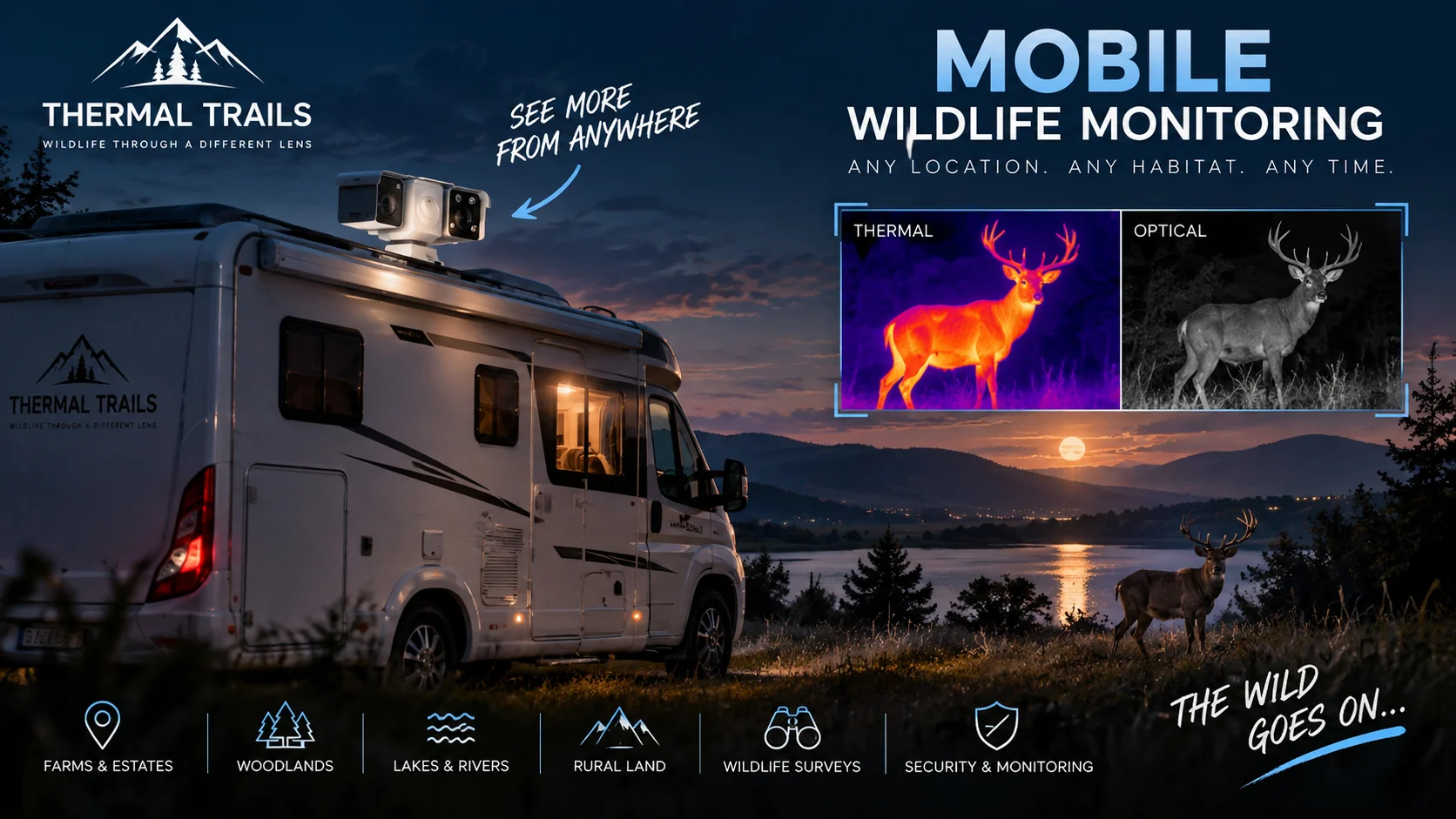
Every location has different sightlines and questions. We agree where to work from, which areas to watch and what you want to learn. The mobile setup lets us observe farms, estates, woodland edges, lakes and other rural habitats from a useful position on site.
Thermal imaging makes warm animals easier to pick out against cooler surroundings. Once activity is found, optical viewing can add the shape, colour and context that help make sense of an encounter. Conditions, distance and cover all affect what can be seen and recorded.
Different tools play different parts in the same watch: find activity, take a closer look and keep a useful record.
A fixed elevated viewpoint helps scan the site for heat signatures and movement after dark, including places that are hard to assess by eye.
A flexible second view for checking field margins, nearby cover and areas outside the main camera’s sightline.
Pan, tilt and zoom lets us follow a sighting and capture optical detail. Its infrared illumination is specified for up to 400 metres; the usable view depends on conditions and the subject.
We can set watched areas so video analytics and intrusion events flag movement. Telegram notifications can bring those triggers to our attention for review.
Tell us about the location, access, known activity and what you would like to understand. We plan where the cameras can give the most useful view.
On site, we use the roof-mounted thermal view, handheld checks and the optical dome together. Alert zones can highlight movement in selected areas.
We look at the footage in context and can share selected clips and observations, including times, location within the site and movement where visible.
An alert marks activity for a closer look; it does not by itself identify a species. A watch is shaped by access, weather, visibility and the agreed purpose.
Which routes are animals using across fields and boundaries?
What appears around clearings and cover after dark?
How does activity change along the bank and across the water?
What movement is taking place in an agreed area overnight?
Tell us where the site is, what you hope to see and when an overnight visit would be useful. We work across Cheshire and the North West.
Observational monitoring is not a replacement for a formal ecological survey or licensed protected-species work.